How to Validate a Brazilian Diploma in the US: A Guide
How to validate a Brazilian diploma in the US: the straight answer
If you search for how to validate a Brazilian diploma in the US, you probably picture an official agency that stamps the diploma and that’s it. That agency does not exist. The U.S. Department of Education itself says it does not evaluate foreign diplomas and asks that no one send evaluation requests to it.
Whoever will receive your document is the one who decides what they accept. That could be the school (to study), the employer (to work), the state licensing board (for regulated professions), or the immigration authority (for visas and green cards). In most cases, these parties ask for a credential evaluation done by a private company, which charges for the service.
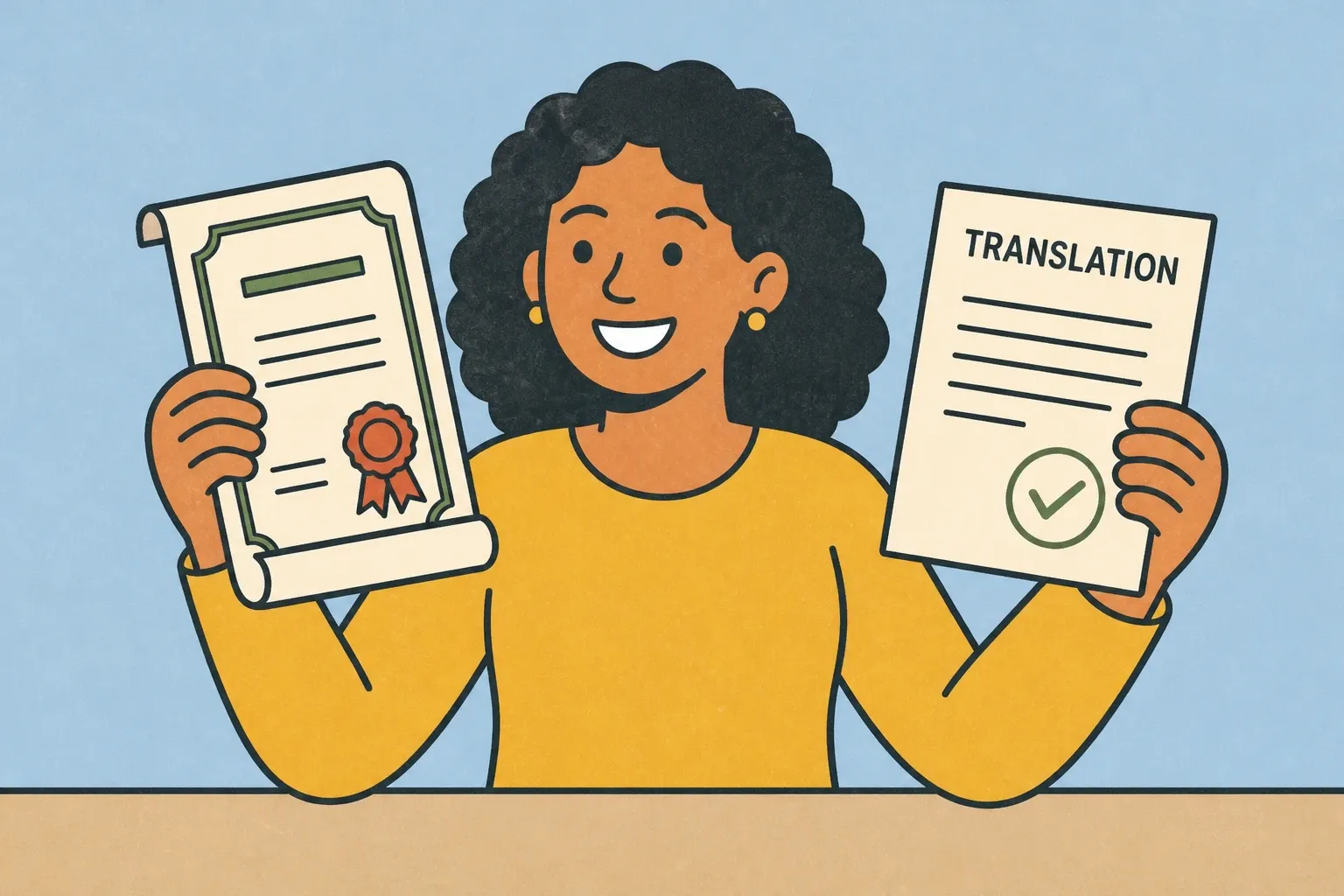
In practice, the process can involve up to two pieces: a certified translation into English and, when the receiving party requires it, a credential evaluation. There is also no federal regulation of these evaluation companies. The official guidance is to use the evaluator named by the school, the employer, or the board, rather than a fixed list that applies to everyone.
It depends on why you need it: college, a job, USCIS, or a regulated profession
What you need changes depending on your purpose. Here’s how it breaks down in each case:
- College: typically, a credential evaluation is required in addition to the translation. The type of report (document-by-document or course-by-course) depends on the program and on whether course credit will be granted.
- A regular job: the employer decides. In most cases, they ask for a credential evaluation done by a private company, but the requirement varies, so ask beforehand.
- USCIS (visa, green card, adjustment of status): the federal rule requires a complete English translation of any document in Portuguese, along with a certificate in which the translator states that the translation is complete and accurate and that they are competent to translate. The rule does not require a Brazilian sworn translator.
- Regulated professions (nursing, engineering, and others): in the US, these professions are licensed at the state level. The state licensing board is the reference authority, and it may do its own evaluation or use a general or profession-specific service.
If you’re unsure, the right question isn’t “what does everyone ask for,” but “what does this specific institution require from me.” It’s worth confirming this before paying for any translation or evaluation.
Sworn translation or certified translation? What WES, ECE, and USCIS actually require
It’s common to see websites, and even AI-generated answers, claiming that a diploma needs a sworn translation to be used in the US. That is not the rule for WES, ECE, or USCIS.
WES requires a translation in evaluations done in the US when the document is not in English, and your WES account shows whether one is needed in your case. WES itself does not do translations. It asks for a literal, word-for-word, legible translation done by a professional translator, for example someone affiliated with a university, a certified translation agency, or another professional translation service.
WES also rejects several types of translations: ones done by the applicant themselves, handwritten ones, incomplete ones, ones made from photocopies, and an English version issued by the university itself in place of an independent translation. A translation in any of these formats is not accepted by WES.
ECE is more flexible. It allows applicants to translate the document themselves, as long as the translation is literal and keeps the format of the original. Another option is to pay an $85 Translation Waiver, and ECE itself translates the document for the report (this option does not apply to NABP requests). This fee can change, so confirm it on the ECE website.
For USCIS, the federal rule (8 CFR 103.2(b)(3)) requires a complete translation with a certificate attesting to its completeness, accuracy, and the translator’s competence. It does not require the translation to be done in Brazil or by a sworn translator.
This settles the question of whether to “translate in Brazil or in the US.” For these three references, what matters is who does and certifies the translation and how it’s done, not the country where it’s produced.
WES or ECE: how credential evaluation works
NACES is an association of credential evaluation companies, founded in 1987, that exists in the absence of a US government agency overseeing these services. NACES itself does not evaluate anything: the evaluating is done by its members, currently 18, including WES and ECE. Members work electronically, so you don’t need to be near any office. The list changes over time, so check the current version on the NACES website.
There are two main types of report:
- Document-by-Document: WES recommends this report for undergraduate admission without credit transfer, job applications, and submissions to US immigration authorities. WES itself recommends confirming with the receiving party whether this type is enough.
- Course-by-Course: lists every course taken with its US credit and grade equivalency, a GPA on a 4.0 scale, and the level of each undergraduate subject. At ECE, it’s the most requested report, chosen by 66% of clients.
WES’s US prices, from the table consulted for this article (WES notes that all fees can change):
| WES Report | Basic | ICAP |
|---|---|---|
| Document-by-Document | $118 | $171 |
| Course-by-Course | $186 | $239 |
Standard delivery costs an additional $14. Confirm the fees on the WES website before placing your order.
As for turnaround time, according to the ECE website (confirm the current timeline before ordering), ECE aims to complete the evaluation in about 5 business days after receiving all the documents. During busy periods it can take longer, which is why it also offers a rush service with a guaranteed 5 business days. A report can also be reused: ECE allows you to request new copies of the same report for up to 5 years from the date it was issued.
Also keep in mind that different evaluators can reach different results, and they usually have their own appeals process. The federal government does not take part in these appeals.
Who sends what: transcripts from the university, translation from you
With WES, the official document and the translation follow different paths, and it’s easy to mix up the two. The official transcript must go directly from the Brazilian university to WES, either by mail in a sealed envelope or through an approved electronic partnership. It is never sent by the applicant, nor by email.
The translation follows a different path. It doesn’t need a sealed envelope: the applicant uploads it as a PDF or JPEG directly to their WES account, and once submitted, it can’t be deleted. That’s why WES recommends asking the university for two sets of official documents, one for WES and one for the translator.
At ECE, when the documents only exist in an envelope sealed by the institution, the translation can be made from an identical copy that you have on hand. Another option is to request two sealed envelopes and open one of them just for the translation. ECE does not return documents received in a sealed envelope.
What about apostilling the diploma? Where does it fit in?
Under Provimento CNJ nº 62/2017, diplomas and transcripts registered in Brazil are treated as public documents and can be apostilled. Part of this provision was later amended by Provimento CN nº 149/2023. So, confirm with the notary’s office (cartório) which rules currently apply.
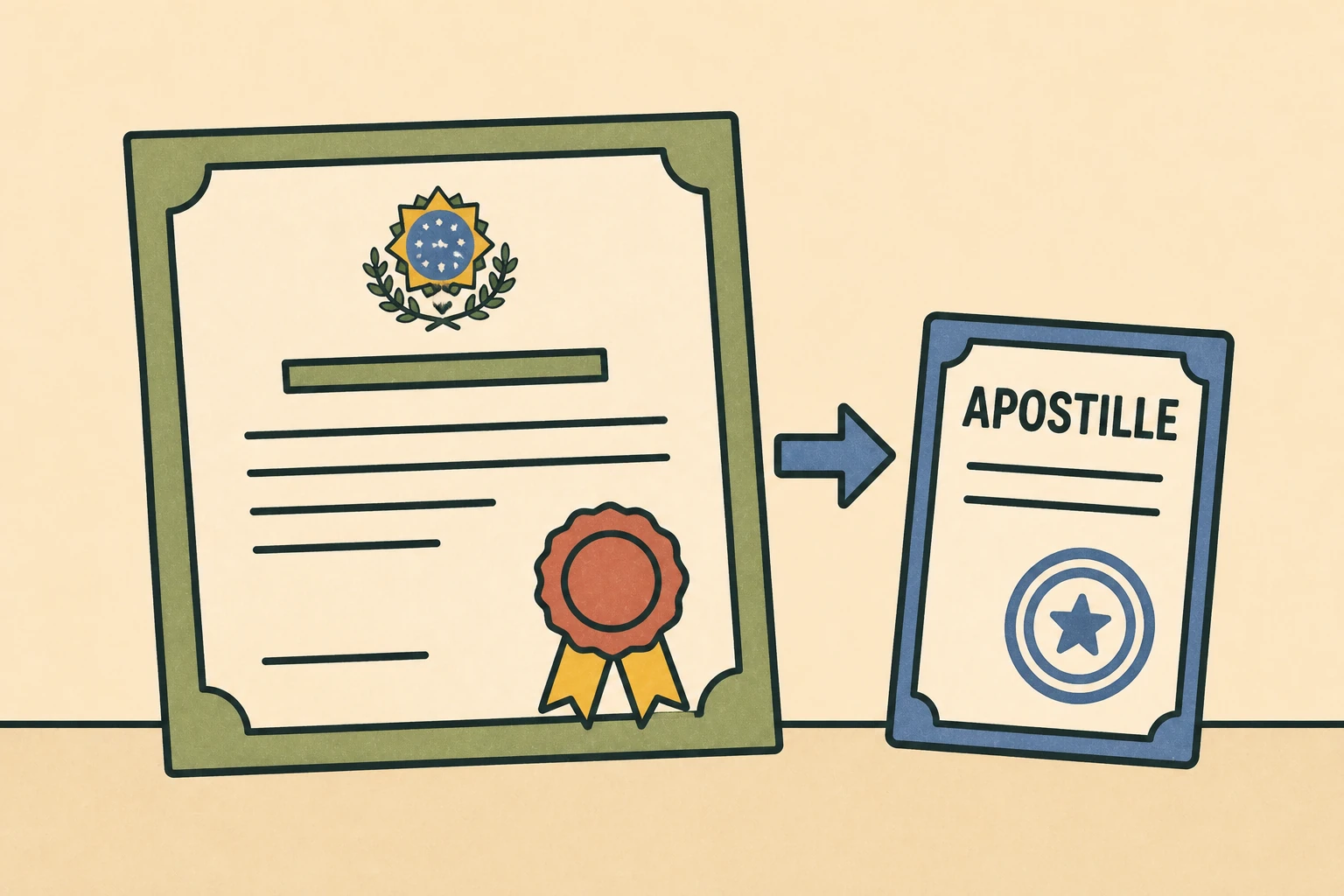
The apostille legalizes the original Brazilian document for international use. It does not replace the certified translation or the credential evaluation that the American party may require. Before seeking an apostille, ask the institution that will receive your diploma whether it actually requires that seal.
Frequently asked questions
Is a medical degree (or another regulated profession’s diploma) automatically accepted in the US?
No. Regulated professions are licensed at the state level in the US. The state licensing board is the reference authority, and it may do its own evaluation or use a profession-specific service. For your particular case, confirm directly with the board in the state where you plan to work.
Does my diploma need to be recognized by the MEC (Brazil’s Ministry of Education) to be accepted in the US?
The official US guidance cited in this article (the Department of Education, WES, and ECE) refers to translation and official institutional documents, and does not list MEC recognition as a requirement. This idea shows up in some online answers without a clear source. Confirm the requirement with whoever will receive your diploma in the US.
Which credential evaluation does USCIS accept for a work visa or green card?
USCIS’s general rule for documents in Portuguese is a complete, certified translation. There’s no federal regulation of evaluation companies, and the Department of Education doesn’t endorse any company or association. For a specific visa or green card application, talk with an immigration lawyer before choosing the type of evaluation.
Can I reuse an evaluation report I’ve already obtained?
It depends on the evaluator. At ECE, you can request new copies of the same report for up to 5 years from the date it was issued. After that, ECE no longer keeps the documents, and you’ll need to open a new request. Confirm the policy directly with the evaluator you used.
How long do the translation and the evaluation take?
According to the ECE website (confirm the current timeline before ordering), ECE aims to complete the evaluation in about 5 business days after receiving all the documents, with a rush option guaranteed in 5 business days. The translation’s timeline depends on who does it. Plan with extra time, since the official transcript also needs to arrive directly from the Brazilian university.
Do I need to send the original diploma, or is a copy enough?
WES recommends not sending originals unless they’re requested, because they are not returned. If the document only exists in a sealed envelope, ECE suggests translating from an identical copy you have on hand or requesting two sealed envelopes. Check the exact requirement with the evaluator before sending anything.
Start with the right translation
Whatever your goal, a translation done outside the required criteria can delay the whole process. Pontal provides academic document translation, such as diplomas and transcripts, done by a professional translator and meeting the criteria that WES and USCIS require. Talk to our team and tell us what you’ll be using your diploma for.