Apostille a US Birth Certificate: 2026 Guide

Where to apostille your child’s US birth certificate
If you need to apostille your child’s US birth certificate to use in Brazil, start here: the apostille is always issued by a US authority. The Brazilian consulate does not apostille a document issued in the United States, and no cartório (Brazilian civil registry office) or agency in Brazil can do it either.
The Conselho Nacional de Justiça (CNJ, Brazil’s National Council of Justice) says this plainly: Brazilian authorities only apostille documents issued in Brazil, and a foreign document must be apostilled in the country that issued it. For a US birth certificate, the right office is the Secretary of State (or equivalent) of the state that issued the certificate.
In New Jersey, apostilles are issued by the Division of Revenue and Enterprise Services, part of the Treasury. In New York, it’s the Department of State. Each state only apostilles documents it issued itself.
The Hague Apostille certifies only the document’s origin: the signature, the position of the person who signed it, and the seal. It does not certify the content of the certificate. It also has no expiration date, but it does not extend the validity of the apostilled document.
Register at the consulate or apostille later? The decision that changes your child’s nationality
A child born in the US to a Brazilian father or mother has two paths to make the birth valid in Brazil. They may look equivalent, but they aren’t, because the child’s nationality ends up recorded differently in each one.
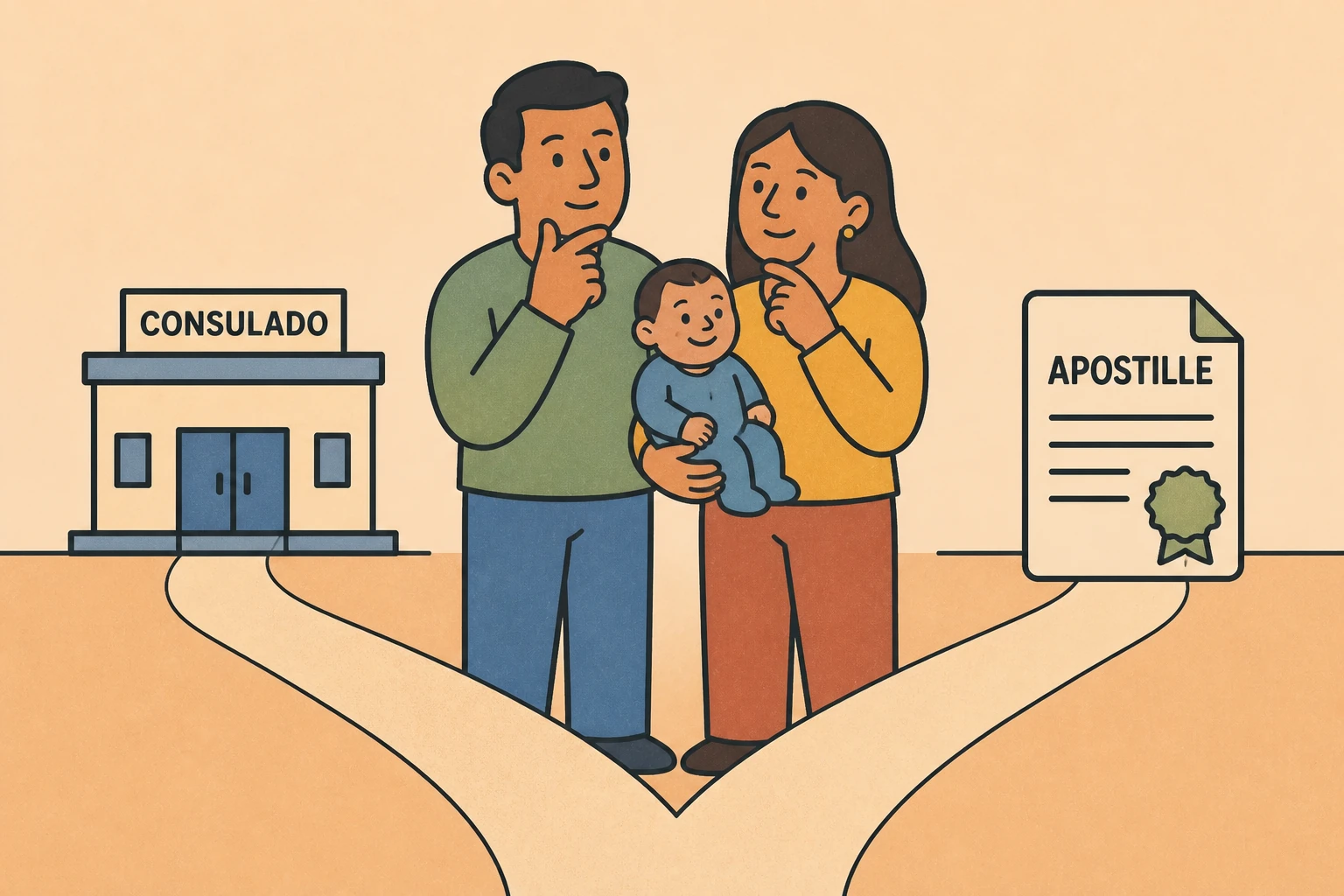
Path 1: consular registration. The Brazilian Constitution states that a child born abroad to a Brazilian father or mother is a natural-born Brazilian citizen if registered at a competent Brazilian consular office. Consular registration is free and requires appearing in person before the consular authority. After that, the consular certificate is transcribed at the 1º Ofício do Registro Civil (the civil registry’s “first office”) in Brazil, and that transcription carries the note “Brasileiro nato” (natural-born Brazilian), with no condition attached.
Path 2: direct transcription of the US certificate. Here the family skips the consulate: they take the apostilled, translated US certificate straight to a Brazilian cartório. The registration goes through, but the record and the certificate carry a note: confirmation of Brazilian nationality depends on the child living in Brazil and making the nationality election, after turning 18, before the Federal Courts (Justiça Federal).
| Consular registration | Direct transcription of the US certificate | |
|---|---|---|
| Source document | Brazilian consular certificate | Apostilled US certificate, with certified translation |
| How nationality appears | “Natural-born Brazilian,” no condition | Depends on residency in Brazil and election after turning 18 |
| Registration cost | Free at the consulate | US apostille fee, plus translation and cartório fees in Brazil |
| Goes through a cartório in Brazil? | Yes, with transcription of the consular certificate | Yes, with transcription of the US certificate |
And the order of steps matters. Consular registration can only be done if the birth hasn’t already been registered at another consulate or at a cartório in Brazil. If you do the direct transcription first, the consular path closes.
So, before you apostille anything, answer one question: has your child’s birth already been registered at the consulate? Of everything in this article, that’s the answer that matters most for deciding what to do with the certificate.
Why the apostille alone doesn’t settle it: certified translation and transcription at the cartório
With the apostille, the US certificate doesn’t need to go through Itamaraty (Brazil’s Ministry of Foreign Affairs) or consulates. But that alone isn’t enough for it to be valid in Brazil. You still need the certified translation and, after that, the transcription at a cartório.
According to the CNJ, a foreign document, even if apostilled, only has legal effect in Brazil with a certified translation, and that translation can only be done in Brazil. Under CNJ Resolution 155/2012, the translator must be a tradutor público juramentado (sworn public translator) registered with a Brazilian junta comercial (board of trade). This step cannot be done in the US.
A lot of people get confused by one detail. The text of CNJ Resolution 155/2012 still refers to a certificate “legalized by a Brazilian consular authority.” But since August 14, 2016, CNJ Resolution 228/2016 establishes that an apostille issued by a country party to the Convention, like the United States, replaces consular legalization. For a US certificate, then, the apostille is enough.
Once translated, the apostilled certificate is transcribed in Book “E” of the 1º Ofício de Registro Civil (first civil registry office) of the county (comarca) where the family is domiciled in Brazil. If the family has no domicile in Brazil, the transcription is done at the 1º Ofício do Distrito Federal. No court authorization is required.
For this transcription, the cartório requires the apostilled and translated foreign certificate, proof or a declaration of domicile, a request signed by the registrant, one of the parents, the legal guardian, or an attorney-in-fact, and a document proving that one of the parents is Brazilian. The documents must be originals. The good news is that the transcription can be requested at any time.
And there’s another advantage: your child’s CPF (Brazilian taxpayer ID) can be recorded at no cost as part of the birth transcription.
How much it costs and how long it takes to apostille in New Jersey and New York
Each state charges its own fee and has its own requirements for which type of copy it accepts. Here’s how it works in New Jersey and New York:
| New Jersey | New York | |
|---|---|---|
| Agency | Division of Revenue and Enterprise Services (Treasury) | Department of State |
| Apostille fee | US$25 per certificate (US$5 for adoption cases) | US$10 per document |
| How to request it | Online Treasury service, possible convenience fee | Same-day in-person service or request by mail |
| Turnaround | Listed within the online service itself | Same day for in-person service, limited to 10 documents per person |
| Apostilles certificates from other states? | No | No |
New Jersey’s fees come from the official fee schedule updated in July 2026. New York’s come from the NY Department of State page, which doesn’t show a date, so check it there before relying on it.
In New Jersey, not every copy of the certificate is accepted for an apostille. The Treasury requires a specific certified copy, with the State Registrar’s original signature.
In New York, certificates issued in New York City (NYC) and by local or county agencies go through an extra certification step before reaching the Department of State. Skipping this step leads to rejection.
And if you live in New Jersey but your child was born in another state, the apostille must be obtained in the state that issued the certificate, because NJ does not apostille certificates from other states.
Common mistakes that delay the apostille process
Some common mistakes delay the process:
- A notarized copy instead of a certified copy. States apostille the certified copy issued by the vital records office. People who work with apostilles every day point to the notarized photocopy as the most common reason for rejection.
- Wrong state. Each state only apostilles the documents it issued. A certificate from another state will be rejected in NJ.
- Wrong type of copy. NJ and NY require specific certified copies, and NYC certificates go through an extra certification step. A copy that doesn’t meet the standard comes back rejected.
- Reading the old wording of CNJ Resolution 155 literally. For Convention countries, like the US, the apostille has replaced consular legalization since 2016.
- Trying to get the certified translation done in the US. To have effect in Brazil, it must be done by a public translator in Brazil.
What the “nationality election” is and when your child will need it
When the US certificate is transcribed directly at the cartório, without consular registration, the birth record notes that Brazilian nationality still depends on confirmation.
In that case, the Constitution provides that the child confirms natural-born Brazilian nationality by coming to live in Brazil and electing it, at any time, after turning 18. The election is made before the Federal Courts (Justiça Federal).
Don’t confuse the two things. The transcription can be done in childhood, at the cartório. The nationality election can only be formalized after the child reaches adulthood, before the Federal Courts.
Every family’s situation is different. When this stage gets closer, talk to a lawyer or to the Federal Courts themselves to see how the rule applies to your child’s case, rather than following a general rule.
Frequently asked questions
Does the birth certificate apostille expire?
No. The apostille certifies the document’s origin and has no expiration date. It also doesn’t renew or extend the validity of the apostilled certificate.
I live in New Jersey, but my child was born in another state. Where do I apostille the certificate?
In the state that issued the certificate. New Jersey’s Division of Revenue and Enterprise Services only apostilles certificates issued in New Jersey. Certificates from other states are apostilled by the relevant agency in the state of origin.
Is there still time to do the transcription if the birth happened years ago?
Yes. Under CNJ Resolution 155/2012, the transcription of a birth that occurred abroad can be requested at any time. What time doesn’t change is the rule for consular registration: it’s only possible as long as the birth hasn’t already been registered at a cartório in Brazil.
Can I get the certificate’s certified translation done here in the United States?
No, not if it will be used in Brazil. According to the CNJ, the certified translation of a foreign document can only be done in Brazil, by a public translator registered with a board of trade (junta comercial). The apostille is done in the US, and the translation, in Brazil.
Can my child’s CPF be included in the certificate transcription?
Yes. Since CNJ Resolution 419/2021, the CPF can be recorded at no cost as part of the transcription of the birth of a Brazilian born abroad.
Do I apostille the certificate before or after the translation?
Before. The apostille is done first, in the United States, by the agency of the state that issued the certificate. The certified translation comes after, in Brazil, and only then does everything go to the cartório for the transcription.
Want help with the US side of things?
Most delays happen on the US side: the wrong copy, a certificate missing the required signature, or a request filed in the wrong state. With Pontal Brazil’s apostille service, we take care of that part for you, in New Jersey and in New York. If you’re still not sure whether the best path for your child is consular registration or the apostille, talk to Pontal and we’ll help you understand your situation.